Bible Search

Verse:
John 3:16; Jn 3:16; John 3

Keyword:
Salvation, Jesus, Gospel

With Operators:
AND, OR, NOT, “ ”

Add this to your site!
Showing posts with label One Currency. Show all posts

Sunday, July 12, 2009

Medvedev Unveils “World Currency” Coin At G8


Russian President shows reporters example of “united future world currency”


Paul Joseph Watson
Prison Planet.com [1]
Friday, July 10, 2009

UPDATE: A close-up image of the coin appears at the bottom of the article.

In a highly symbolic moment at the G8 summit in Italy today, Russian President Dmitry Medvedev unveiled to reporters a coin representing a “united future world currency”.

“We are discussing both the use of other national currencies, including the ruble, as a reserve currency, as well as supranational currencies,” the Russian leader said at a news conference.

However, those who have downplayed the formulation of a world currency by dismissing it as merely a progression of SDR’s (Special Drawing Rights) and not something that would physically be used by citizens in a system of world government, were contradicted when Medvedev clearly outlined that the new currency would be “used for payment” by citizens as a “united future world currency”.

“This is a symbol of our unity and our desire to settle such issues jointly,” Medvedev said.

“Here it is,” Medvedev told reporters today in L’Aquila, Italy, after a summit of the Group of Eight nations. “You can see it and touch it,” reports Bloomberg [3].

The question of a supranational currency “concerns everyone now, even the mints,” Medvedev said. The test coin “means they’re getting ready. I think it’s a good sign that we understand how interdependent we are.”

Medvedev explained that the coin had been minted in Belgium and bears the words “unity in diversity”. An RIA Novosti report [4]noted that the coin represented an example of a “possible global currency”.

China and Russia have repeatedly called for a new global currency to replace the dollar.

When confronted about plans [5] to supplant the dollar with a new global currency, both Federal Reserve chairman Ben Bernanke and Treasury Secretary Timothy Geithner denied that such an agenda existed.

However, just days after he told a Congressional hearing that there were no plans to move towards a global currency, Geithner sought to please the elitist CFR by assuring them that he was “open” to the notion of a new global currency system [6].

The scandal-ridden and highly secretive Bank For International Settlements, [7] considered to be the world’s top central banking power hub, released a policy paper in 2006 that called for the end of national currencies in favor of a global model of currency formats.

The global currency would be a key central plank of a future system of world government. Earlier this week, Pope Benedict called for a “world political authority” [8] to manage the global economy.

[worldcoin.jpeg]


URL to article: http://www.prisonplanet.com/medvedev-unveils-world-currency-coin-at-g8.html

URLs in this post:

[1] Prison Planet.com: http://prisonplanet.com/

[2] Image: http://prisonplanet.tv/signup.html

[3] reports Bloomberg: http://www.bloomberg.com/apps/news?pid=20601087&sid=aeFVNYQpByU4

[4] RIA Novosti report : http://en.rian.ru/russia/20090710/155494340.html

[5] When confronted about plans: http://www.prisonplanet.com../obama-denounces-global-currency-while-creating-the-very-means-for-its-introduction.html

[6] “open” to the notion of a new global currency system: http://www.prisonplanet.com../two-faced-geithner-assures-cfr-puppet-masters-hes-open-to-global-currency.html

[7] Bank For International Settlements,: http://www.prisonplanet.com../articles/february2006/210206globalcurrency.htm

[8] Benedict called for a “world political authority”: http://www.prisonplanet.com../pope-calls-for-global-government-to-manage-economy.html


Monday, April 20, 2009

A Bigger, Bolder Role Is Imagined For the IMF

Changes Suggest Shift in How Global Economy Is Run

By Anthony Faiola
Washington Post Staff Writer
Monday, April 20, 2009 

Inside a cavernous assembly hall in downtown Washington, dignitaries gather twice a year for routine meetings of the International Monetary Fund. Before long, though, the room could take center stage in the IMF's transformation into a veritable United Nations for the global economy.

Surrounded by blond wood paneling and a digital screen the size of a cinema's, central bankers and finance ministers would meet to convene a financial security council of sorts. Serving almost as ambassadors to the IMF, they would debate ways to put out the world's economic fires and stifle reckless policies before they ignite new ones.

Bowing to a new economic world order, the IMF would grant fresh powers to the likes of China, India and Brazil. It would have vastly expanded authority to act as a global banker to governments rich and poor. And with more flexibility to effectively print its own money, it would have the ability to inject liquidity into global markets in a way once limited to major central banks, including the U.S. Federal Reserve.

That image of a radically transformed IMF -- whose role in the global economy had turned largely advisory in recent years -- is now coming together through internal IMF documents, interviews and think-tank reports. Finance ministers from major nations will begin grappling with the formidable details of the IMF's makeover this weekend when they converge in Washington for the fund's biannual assembly.

The changes, broadly outlined by President Obama and other leaders of the Group of 20 nations in London earlier this month, could take months, even years to take shape. But the IMF is all but certain to take a central role in managing the world economy. As a result, Washington is poised to become the power center for global financial policy, much as the United Nations has long made New York the world center for diplomacy.

The IMF's mission is expanding so broadly that its managing director, Dominique Strauss-Kahn, said in an interview that the organization -- which underwent deep cuts last year before the financial crisis swept the globe -- may boost staffing in coming months, potentially creating dozens of high-paying jobs in the District.

"The IMF is changing, and with it, there will be a sea change in the way the world economy is run," said C. Fred Bergsten, director of the Peterson Institute for International Economics. "Their role will dramatically shift. You're talking about monitoring fiscal stimulus, moving toward tighter regulations for financial institutions. You're talking about global economic management in a way we have never seen."

Already, the economic crisis is triggering a profound cultural shift, with the IMF moving away from its long-held mission to spread the gospel of capitalism around the globe.

Founded at the end of World War II to maintain stability in global currency markets, it later became known as the lender of last resort for nations in crisis, particularly as financial fires raced across Asia and Latin America in the 1990s. Its bailouts, however, were the bane of many poor countries; they often came with demands for fiscal austerity and free-market reform as the cures for developing nations -- even if that meant nations had to cut back on programs for health care and schools.

The IMF, Strauss-Kahn suggested, will become less ideological. Critics maintain the fund is still attaching too many restrictions to its longer-term bailouts for poor countries. But the IMF has signed off in recent weeks on no-strings-attached credit lines for countries with solid economic track records, offering $47 billion to Mexico and $20.5 billion to Poland.

"If the fund is considering a country and is technically convinced that privatization of any enterprise is needed to fix the country today, let's privatize. But if it's a general idea of privatization that has nothing to do with the problem, let's forget it," Strauss-Kahn said. "At the same time, if nationalization will help, let's do it."

Developing nations -- including some that were once down-and-out clients of the fund -- are now coming to the IMF's rescue as part of the pledge made by leaders in London to beef up the organization's war chest to $1 trillion. In exchange for better representation on the governing board, China, which has fewer voting rights than Belgium, is set to give more than $40 billion. Brazil, which received a massive IMF bailout in the late 1990s, is pledging $4.5 billion.

There is even talk that the next managing director -- traditionally a European, while an American ran its sister organization, the World Bank -- may come from the developing world. "Why not?" Strauss-Kahn said.

For an organization long demonized by the developing world, such changes were once unthinkable. "I spent 20 years of my life carrying posters that said 'IMF out,' " Brazilian President Luiz Inácio Lula da Silva, a former union leader, said last week in Rio de Janeiro. "Now the minister of finance says we are going to lend money to the IMF."

The IMF is also moving toward taking the lead role as the global economic watchdog. An intense debate, however, remains over the scope of the edicts it may issue as well as the power it will be granted to enforce them.

Along with the Switzerland-based Financial Stability Board, the IMF is set to develop benchmarks for financial governance, from guidelines on executive pay to methods to prevent the spread of toxic assets through global banks. But no one is talking seriously about allowing the IMF to impose sanctions to force compliance as the United Nations does. There is even a strong reluctance to grant the IMF powers such as those held by the World Trade Organization in Geneva, which issues binding rulings on violations of global trade law.

Instead, the IMF is likely to wield what Strauss-Kahn called "the strength of truth telling." Put another way, the organization's public pronouncements would carry the force of the nations seated at its table, including the world's most powerful industrialized and developing economies.

Some critics, however, say that may not be enough. A case in point: An internal IMF document recently called for Eastern European nations to adopt the euro as their currency to stabilize their economies, even without the approval of euro-zone nations. But stiff opposition from Western Europe has thus far prevented that document from being made public.

Additionally, some smaller European and low-income nations remain skeptical about the creation of a financial security council, arguing they would not be well represented. Even within the IMF, there is a debate over the council's purview and makeup. Some see the council turning into a venue to hash out major economic disputes, such as U.S. and European charges that China is keeping its currency artificially weak.

Others say it should steer away from country-specific rulings. Another camp argues the fund should not exist at all. Even Strauss-Kahn has sought to dispel the notion of too grand a role for the IMF, saying its primary mission should remain monitoring and surveillance rather than enforcement.

"The fund is supposed to take on a more regulatory role, holding accountable even wealthy countries," said Moshin Khan, the IMF's former Middle East and Central Asia director. "But I will have to see that happen to believe it. Whenever I've seen them going after the bigger countries, if the countries don't like what the fund has to say, the fund doesn't say it."

Tuesday, April 07, 2009

What will it take for you to believe?

The G20 moves the world a step closer to a global currency

The world is a step closer to a global currency, backed by a global central bank, running monetary policy for all humanity.


"We have agreed to support a general SDR allocation which will inject $250bn (£170bn) into the world economy and increase global liquidity," it said. SDRs are Special Drawing Rights, a synthetic paper currency issued by the International Monetary Fund that has lain dormant for half a century.

In effect, the G20 leaders have activated the IMF's power to create money and begin global "quantitative easing". In doing so, they are putting a de facto world currency into play. It is outside the control of any sovereign body. Conspiracy theorists will love it.

It has been a good summit for the IMF. Its fighting fund for crises is to be tripled overnight to $750bn. This is real money.

Dominique Strauss-Kahn, the managing director, said in February that the world was "already in Depression" and risked a slide into social disorder and military conflict unless political leaders resorted to massive stimulus.

He has not won everything he wanted. The spending plan was fudged. While Gordon Brown talked of $5 trillion in global stimulus by 2010, this is mostly made up of packages already under way.

But Mr Strauss-Kahn at least has resources fit for his own task. He will need them. The IMF is already bailing out Pakistan, Iceland, Latvia, Hungary, Ukraine, Belarus, Serbia, Bosnia and Romania. This week Mexico became the first G20 state to ask for help. It has secured a precautionary credit line of $47bn.

Gordon Brown said it took 15 years for the world to grasp the nettle after Great Crash in 1929. "This time I think people will agree that it has been different," he said.

President Barack Obama was less dramatic. "I think we did OK," he said. Bretton Woods in 1944 was a simpler affair. "Just Roosevelt and Churchill sitting in a room with a brandy, that's an easy negotiation, but that's not the world we live in."

There will be $250bn in trade finance to kick-start shipping after lenders cut back on Letters of Credit after September's heart attack in the banking system. Global trade volumes fell at annual rate of 41pc from November to January, according to Holland's CPB institute – the steepest peacetime fall on record.

Euphoria swept emerging markets yesterday as the first reports of the IMF boost circulated. Investors now know that countries like Mexico can arrange a credit facility able to cope with major shocks – and do so on supportive terms, rather than the hair-shirt deflation policies of the old IMF. Fear is receding again.

The Russians had hoped their idea to develop SDRs as a full reserve currency to challenge the dollar would make its way on to the agenda, but at least they got a foot in the door.

There is now a world currency in waiting. In time, SDRs are likely evolve into a parking place for the foreign holdings of central banks, led by the People's Bank of China. Beijing's moves this week to offer $95bn in yuan currency swaps to developing economies show how fast China aims to break dollar dependence.

French President Nicolas Sarkozy said the summit had achieved more than he ever thought possible, and praised Gordon Brown for pursuing the collective interest as host rather than defending "Anglo-Saxon" interests. This has a double-edged ring, for it suggests that Mr Brown may have traded pockets of the British financial industry to satisfy Franco-German demands. The creation of a Financial Stability Board looks like the first step towards a global financial regulator. The devil is in the details.

Hedge funds deemed "systemically important" will come under draconian restraints. How this is enforced will determine whether Mayfair's hedge-fund industry – 80pc of all European funds are there – will continue to flourish.

It seems that hedge funds have been designated for ritual sacrifice, even though they played no more than a cameo role in the genesis of this crisis. It was not they who took on extreme debt leverage: it was the banks – up to 30 times in the US and nearer 60 times for some in Europe that used off-books "conduits" to increase their bets. The market process itself is sorting this out in any case – brutally – forcing banks to wind down their leverage. The problem right now is that this is happening too fast.

But to the extent that this G20 accord makes it impossible for the "shadow banking" to resurrect itself in the next inevitable cycle of risk appetite, it may prevent another disaster of this kind.

The key phrase is "new rules aimed at avoiding excessive leverage and forcing banks to put more money aside during good times." This is more or less what the authorities agreed after the Depression. Complacency chipped away at the rules as the decades passed. It is the human condition, and we can't change that.

Thursday, April 02, 2009

G20 leaders seal $1tn global deal

Leaders of the world's largest economies have reached an agreement to tackle the global financial crisis with measures worth $1.1 trillion (£681bn).

To help countries with troubled economies, the resources available to the International Monetary Fund (IMF) will be tripled to $750bn.

There will also be sanctions against secretive tax havens and tougher global financial regulation.

And the G20 has committed about $250bn to boost global trade.

US President Barack Obama said the summit could mark a "turning point" in the pursuit of economic recovery and made progress in reforming a "failed regulatory system".

NEW FUNDING PLEDGES
$500bn for the IMF to lend to struggling economies
$250bn to boost world trade
$250bn for a new IMF "overdraft facility" countries can draw on
$100bn that international development banks can lend to poorest countries
IMF will raise $6bn from selling gold reserves to increase lending for the poorest countries Source: BBC
"By any measure the London summit was historic.

"It was historic because of the size and the scope of the challenges that we face and because of the timeliness and the magnitude of our response," he said.

Prime Minister Gordon Brown said there was "no quick fix" for the world economy but there was a commitment to do whatever was necessary.

"This is the day that the world came together to fight back against the global recession, not with words, but with a plan for global recovery and for reform and with a clear timetable for its delivery," Mr Brown said.

Another G20 meeting will be held in New York in September to check on progress, the BBC has learned.

The deal was announced shortly before the European stock markets closed and gave leading indexes a significant boost.

London's FTSE 100 index of leading shares ended 4.3% higher. In Paris, the Cac 40 jumped 5.4% and in Frankfurt, the Dax rose 6%.

The deal

On behalf of the G20, Mr Brown announced the following steps:

Bankers' pay and bonuses will be subject to stricter controls
A new Financial Stability Board will be set up to work with the IMF to ensure co-operation across borders and provide an early warning mechanism for the financial system
There will be greater regulation of hedge funds and credit ratings agencies
A common approach to cleaning up banks' toxic assets has been agreed
The world's poorest countries will receive $100bn extra aid
G20 countries are already implementing the biggest economic stimulus "the world has ever seen" - an injection of $5tn by the end of next year.
IMF boost

The IMF has been one of the biggest beneficiaries of the G20 summit.

The resources it has to help troubled economies will be increased to $500bn.

An overdraft facility will also be increased to $250bn (in the IMF's currency, so-called Special Drawing Rights) that all members can call upon.

Mr Brown said that there would be a crackdown on tax havens to prevent the loss of sorely needed tax revenue.

Shortly after the summit finished the Organisation of Economic Co-operation and Development published a blacklist of countries deemed uncooperative.

It said Costa Rica, Malaysia, Philippines and Uruguay had not made any commitment to respecting international standards.

"We have agreed tough standards and sanctions for use against those who don't come into line in the future," Mr Brown said.

President Obama was said to have played a key role in brokering the agreement on tax havens, resolving differences between France and China.

Hopes met?

French President Nicolas Sarkozy said that the conclusions of the G20 summit were "more than we could have hoped for". HAVE YOUR SAY 1.1 trillion...how can that ever be accounted for? Success for them. Failure for everyone else Nathan McConnell, Grantsburg, US

Earlier, there had been suggestions of rifts between France and Germany and the US and the UK.

The US and UK emphasised the need for public spending to ease the crisis while France and Germany were keen for tougher financial regulation.

Mr Sarkozy had threatened to walk out of the meeting if it did not yield concrete results.

German Chancellor Angela Merkel also praised the outcome.

She said the new measures would give the world a "clearer financial market architecture" and the agreement was "a very, very good, almost historic compromise".

Her finance minister, Peer Steinbrueck, said he was pleased that the G20 statement did not oblige states to launch further economic stimulus packages.

Protests

Protesters gathered outside the summit, but in smaller numbers than during Wednesday's demonstrations in London's financial district.

Several hundred staged "noisy but calm" protests near the Excel centre, representing groups including the Stop the War Coalition and CND.

And about 400 more demonstrators were boxed in by police outside the Bank of England in London's financial district, during angry but peaceful protests.

More than 100 people were arrested over the two days of protests - 86 of them on Wednesday, police said.

A small group of protesters gathered earlier at the London Stock Exchange, but later dispersed.

Poor benefit

The G20 countries have pledged $100bn in aid for developing countries, more than expected.

The money will be dispensed through multilateral lenders such as the Asian Development Bank.

The measure that could make the most difference in the short term for the poorest countries is the availability of $250bn of trade credit, says BBC international development correspondent David Loyn.

It will enable goods currently rotting on the quayside in Africa to move again, he says.

BBC business editor Robert Peston said the tougher financial regulation announced by the G20 was a significant step.

He said it sounded the death knell for the freewheeling Anglo-American way of banking and conducting financial markets.

However, he said the measures would not get the world out of recession overnight.

Story from BBC NEWS:
http://news.bbc.co.uk/go/pr/fr/-/2/hi/business/7979483.stm

Friday, March 27, 2009

BBC Host and HuffPo Blogger Warns of U.S. Military Action if China Pushes for Global Currency

Max Keiser tells Aljazeera English that countries won't push toward a global currency for fear 'U.S. Marines are going to show up in our backdoor.'

By Jeff Poor
Business & Media Institute
3/27/2009 4:09:46 PM

It’s has been in the news a lot lately, and the prospects of a global currency have Max Keiser, Huffington Post blogger and host of BBC World’s “The Oracle,” giving dire warnings of the consequences if China or other countries were to make a push for it.

Keiser appeared on Aljazeera English’s March 27 “Inside Story” to discuss the possibilities of a global currency. Host Darren Jordon asked Keiser about the pitfalls of converting to a global currency and Keiser used it as an opportunity to launch into an anti-American diatribe.

“Well, the pitfalls are for the U.S.,” Keiser said. “The U.S. has what [former French President Charles] de Gaulle called an extraordinary privilege – they can write checks that they never have to cash. They just print new dollars. This has been going on since Bretton Woods at the end of World War II.”

Keiser insisted it was the United States that had a lot to lose and that China, a big player in the global economy, would be reluctant to push for a stronger currency than the U.S. dollar for fear of retribution.

“So, America has everything to lose and they’re going to resist the new global currency every way that they possibly can,” Keiser said. “China would obviously love to be able to do their business in currencies outside of the U.S. dollar. But look what happened in the Mideast.”

The Huffington Post blogger pointed to the invasion of Iraq and America’s strong warning to Iran over its nuclear activity.

“Look what happen to Saddam Hussein when he tried to start to trade oil in Euros,” Keiser said. “He was bombed and then assassinated by the U.S. Look what happened in Iran when they started talking about trading oil and gas in Euros. Suddenly America is saber-rattling in Iran.”

So in Keiser’s view, the Chinese won’t jump onboard the global currency bandwagon out of fear of the U.S. military.

“So any country looks at those examples and they say, ‘You know if we get out of the U.S. dollar, does this mean that U.S. Marines are going to show up in our backdoor and start to cause mischief?’” Keiser said. “That’s a legitimate concern these countries have.”

But even the Aljazeera host was skeptical the United States would launch a military response if China made a push toward a global currency.

“OK, well, I’m not so sure the American Marines would turn up on the streets of Beijing, Max,” Jordon said.

This is type of insight that might normally be expected from Aljazeera, the Huffington Post or even the BBC. However, the editor-in-chief of the Huffington Post Arianna Huffington is slated to appear as a guest host on the more mainstream CNBC “Squawk Box” on March 31.

Rep. Michele Bachmann, R-Minn., has introduced legislation that would prevent the introduction of a multi-national currency into the American economy on March 25.

Wednesday, March 25, 2009

Obama Denounces Global Currency While Creating The Very Means For Its Introduction

Posted By admin On March 25, 2009 @ 9:26 am In Featured Stories

Paul Joseph Watson
Prison Planet.com
Wednesday, March 25, 2009
Obama, Geithner and Bernanke yesterday publicly defended the dollar and denounced proposals by China and Russia to supplant the greenback with a new global currency, and yet the very policies of the Obama administration, the Treasury and the Federal Reserve are creating the perfect storm for the dollar’s death and its replacement with a new international reserve currency.

As we reported on Monday, China has expressed support for Russia’s proposal to hand the IMF the power to create a new supra-national global currency in response to the call for an alternative to the U.S. dollar as the world reserve currency.

Last week the Kremlin called for the “creation of a supranational reserve currency to be issued by international institutions as part of a reform of the global financial system.”

Yesterday, Barack Obama, Timothy Geithner and Ben Bernanke all separately expressed support for the dollar and denounced the Chinese-Russian proposal for a new global currency.

“… The dollar is extraordinarily strong right now,” said Obama during his prime-time press conference. “The reason the dollar is strong right now is because investors consider the United States the strongest economy in the world, with the most stable political system in the world. So, you don’t have to take my word for it.”

When asked if he supported the introduction of a new global currency, Obama flatly stated, “No, I don’t support a global currency.”

During Tuesday’s congressional hearing, both Geithner and Bernanke echoed Obama’s statement.

“Would you categorically renounce the United States moving away from the dollar and going to a global currency as suggested by China?” a lawmaker asked Treasury Secretary Geithner.

Geithner immediately responded, “I would.”

“And the chair?” the lawmaker asked, after turning to Fed chairman Bernanke.

“I would also,” Bernanke said.

The creation of a new supra-national global reserve currency to supplant the U.S. dollar would likely lead to a complete collapse of the greenback, of which trillions are held in in foreign exchange reserves by foreign countries such as China and Japan.

In the case of Obama, Geithner and Bernanke, actions certainly speak louder than words, because while publicly denouncing the demise of the dollar and the call for a new global currency, their every policy is creating the very means and justification for its introduction.

Bernanke himself has vehemently supported efforts to create a global regulatory framework that would act as the vehicle for the introduction of a new global currency to replace the dollar.

He has echoed the sentiments of Blair, Brown, Merkel, Sarkozy and others in calling for a new world economic order and “A strategy that regulates the financial system as a whole, in a holistic way, not just its individual components,” Bernanke told a CFR audience at a speech earlier this month.

“I also will not say much about the international dimensions of the issue but will take as self-evident that, in light of the global nature of financial institutions and markets, the reform of financial regulation and supervision should be coordinated internationally to the greatest extent possible,” said Bernanke, adding that the crisis is “very much an international problem, and it requires international solutions.”

The endgame of a form of supervision “coordinated internationally to the greatest extent possible” can mean little else but the creation of a global currency that can be tightly regulated and controlled by international bodies such as the IMF and World Bank, therefore Bernanke’s public denouncement of a “global currency” is nothing more than a two faced stunt.

In addition, as Ron Paul has warned, Bernanke’s policies are leading to the destruction of the dollar and the creation of a vacuum that would create the perfect pretext for the introduction of a global currency.

Trillions upon trillions of freshly printed federal reserve notes that are being used to throw good money after bad, pay corrupt banker’s bonuses and bailout failed, inept and incompetent banks and corporations at the expense of the taxpayer are going to create a hyperinflationary holocaust that will plunge the dollar into a crisis never before experienced and will undoubtedly put massive pressure on China and Japan to liquidate their holdings of U.S. debt and replace it with a new form of international reserve currency.

The fact that banks are still holding on to the trillions printed since September last year has delayed any significant inflationary impact, but when the lending starts again, confidence in the greenback’s ability to act as an international reserve currency will sink and calls for its replacement will reach a crescendo.

Treasury Secretary Geithner has played a leading role in the wholesale looting of the greenback, announcing this week that the printing presses will be cranked to the tune of at least another $1 trillion to buy more “toxic assets” from the sagging balance sheets of failing institutions - again, all at the expense of the taxpayer who will pay for it with rampant tax hikes and runaway inflation on fuel and food later down the road.

This will mirror the situation in Iceland, where massive devaluation of the krona has destroyed savings and led to calls for the country to abandon their currency altogether and join the Euro. A similar fate awaits the U.S. with “helicopter Ben” and his loyal sidekick Geithner doing everything in their power to destroy the dollar’s value with ceaseless so-called “stimulus” plans.

Some analysts have gone even further, suggesting that the hyperinflationary backlash will not be on a par with Iceland, but with Zimbabwe, where the Zimbabwean dollar has suffered annual inflation of over 200 million per cent over the last few years.

Of course, the pound sterling and the Euro, on the back of identical hyperinflation caused by central banks overprinting money, will also collapse, leaving no alternative but for the introduction of a new global reserve currency to “restore confidence”.

And so we turn to Obama - the man who has used his political capital, slick speeches and confident smile to oversee the greatest destruction of American wealth since the great depression. Obama has acted as the slimy salesman for the introduction of Bernanke and Geithner’s multi-trillion dollar programs that can have no other effect but to weaken the position of the dollar as the global reserve currency, so for him to glibly express his opposition to a new global reserve currency that will replace the dollar is an act of gut-wrenching hypocrisy.

Obama has continually demonized private enterprise in favor of government intervention and has acted as the engine for the gargantuan transfer of wealth from American taxpayers to the Wall Street oligarchs that pull his strings.

While publicly denouncing a move towards a global currency yesterday, Obama has conversely announced that he will pursue a new world economic order, a “new global deal” in alliance with British Prime Minister Gordon Brown.

When we hear the terms “new world economic order,” and a “new global deal,” they are interchangeable with the agenda to create a new global currency. It’s all about taking more power and centralizing it into fewer hands and creating a de facto banking dictatorship that will have complete control over global currencies and exchange rate mechanisms.

Obama, Geithner and Bernanke are the three biggest culprits behind the destruction of the dollar and are culpable for creating the perfect storm for its replacement with a new global reserve currency - so for all three to claim yesterday that they support a strong dollar and oppose a global currency is like Bernie Madoff lecturing you that Ponzi schemes are immoral.

Wednesday, March 18, 2009

IMF poised to print billions of dollars in 'global quantitative easing'

The International Monetary Fund is poised to embark on what analysts have described as "global quantitative easing" by printing billions of dollars worth of a global "super-currency" in an unprecedented new effort to address the economic crisis.

By Edmund Conway
Last Updated: 9:07AM GMT 16 Mar 2009

Alistair Darling and senior figures in the US Treasury have been encouraging the Fund to issue hundreds of billions of dollars worth of so-called Special Drawing Rights in the coming months as part of its campaign to prevent the recession from turning into a global depression.
Should the move, which is up for discussion by the summit of G20 finance ministers this weekend, be adopted, it will represent a global equivalent of the Bank of England's plan to pump extra cash into the UK economy.


However, economists warned that the scheme could cause a major swell of inflation around the world as the newly-created money filters through the system. The idea has been suggested by a number of key figures, including billionaire investor George Soros and US Treasury adviser Ted Truman.
Simon Johnson, former chief economist at the IMF, said: "The principle behind it is that everyone would get bonus dollars and instead of the Federal Reserve having to print them, everyone gets them.
"The objective is to create a windfall of cash. However if everybody goes out and spends the money it could be very inflationary."

-London Telegraph

Sunday, February 22, 2009

'Nationalize' the Banks

Dr. Doom says a takeover and resale is the market-friendly solution.
By TUNKU VARADARAJAN

New York

Nouriel Roubini is always dressed in black-and-white.

I have known him for nearly two years, and have seen him in a variety of situations -- en route to class at New York University's Stern Business School, where he's a professor; over a glass of wine in his boyish loft in Manhattan's Tribeca; at an academic conference, seated sagely on the dais; at a bohemian party in Greenwich Village, at . . . oh . . . 3 a.m. -- and he always, always wears a black suit with a white linen shirt.

And so, in black-and-white he was, earlier this week, when he rushed into the office of Roubini Global Economics, his consulting firm in downtown Manhattan, and offered a breathless apology to this correspondent, who'd been waiting for half an hour. "Really sorry I'm late! Charlie Rose taped for way longer than he said he would."

Mr. Roubini -- a month short of 50 -- is in huge media demand, the nearest thing to a rock-star among the economists who hold our fate in their hands these days. The peculiar thing, of course, is that he's in demand because he specializes in predictions of gloom. (He has earned himself the sobriquet of "Doctor Doom.") In person, though, he's anything but a downer.

The man has instant impact on public debate. An idea he floated only last week -- that our "zombie banks" be temporarily nationalized -- aired first on Forbes.com, where he writes a weekly column. It has evolved, in the space of just a few days, from radical solution to almost received wisdom.

Last Sunday on ABC, George Stephanopoulos asked Lindsey Graham, the conservative Republican senator, what he thought about all this talk of bank nationalization. Mr. Graham said that he wouldn't take the idea off the table. And on Wednesday, Alan Greenspan told the Financial Times that "it may be necessary to temporarily nationalize some banks in order to facilitate a swift and orderly restructuring."

Mr. Roubini tells me that bank nationalization "is something the partisans would have regarded as anathema a few weeks ago. But when I and others put it in the context of the Swedish approach [of the 1990s] -- i.e. you take banks over, you clean them up, and you sell them in rapid order to the private sector -- it's clear that it's temporary. No one's in favor of a permanent government takeover of the financial system."

There's another reason why the concept should appeal to (fiscal) conservatives, he explains. "The idea that government will fork out trillions of dollars to try to rescue financial institutions, and throw more money after bad dollars, is not appealing because then the fiscal cost is much larger. So rather than being seen as something Bolshevik, nationalization is seen as pragmatic. Paradoxically, the proposal is more market-friendly than the alternative of zombie banks."

In any case, Republicans must now temper their reactions, he says. "The kind of government interference in the economy that we saw in the last year of Bush was unprecedented. The central bank -- supposed to be the lender of the last resort -- became the lender of first and only resort! With our recapitalizing of financial institutions, and massive government intervention in the markets, we've already crossed a significant bridge."

So, will the highest level of government be receptive to the bank-nationalization idea? "I think it will," Mr. Roubini says, unhesitatingly. "People like Graham and Greenspan have already given their explicit blessing. This gives Obama cover." And how long will it be before the administration goes in formally for nationalization? "I think that we're going to see the policy adopted in the next few months . . . in six months or so."

That long? I ask. "Six months from now," he replies, "even firms that today look solvent are going to look insolvent. Most of the major banks -- almost all of them -- are going to look insolvent. In which case, if you take them all over all at once, you cause less damage than if you would if you took over a couple now, and created so much confusion and panic and nervousness.

"Between guarantees, liquidity support, and capitalization, the government has provided between $7 trillion to $9 trillion of help to the financial system. De facto, the government is already controlling a good chunk of the banking system. The question is: Do you want to move to the de jure step."

Yet another reason why bank nationalization is a good idea, Mr. Roubini continues, is that "we started with banks that were too big to fail, but what has happened, in the process, is that these banks have become even-bigger-to-fail. J.P. Morgan took over Bear Stearns and WaMu. BofA took over Countrywide and then Merrill. Wells Fargo took over Wachovia. It doesn't work! You can't take two zombie banks, put them together, and make a strong bank. It's like having two drunks trying to keep each other standing.

"So if you took over a big bank, and you split the assets in three or four pieces, maybe you create three or four regional or national banks, and they're stronger! Nationalization -- or 'temporary receivership,' if you like, if the N-word is a political liability -- is an occasion to undo the sort of consolidation that has created an even bigger systemic problem. And the only way to do it is by essentially taking them over and breaking them up."

Here, I ask Mr. Roubini whether he has been more right -- more prescient -- in his reading of the economic downturn than all the other famous bears in America. After all, judging by the attention paid to him in the press, it is hard not to conclude that he is the leading guru of the current recession, or "near-depression," as he often calls it. My question, remarkably, induces in him some diffidence. "I don't want to personalize the analysis, you know . . . because, first of all, there were many people who got many of the elements right.

"People like [Robert] Shiller were very worried about the housing bubble. People like Steve Roach were worried about an economy based on asset bubbles leading to consumption bubbles that were unsustainable. People like Ken Rogoff talked about global imbalances in the current account deficit not being sustainable. Nassim Taleb has been worrying for a while about 'fat tail' events . . . . So lots of people signaled concern about things. I was one of those who put the dots together and thus gave a more fleshed-out picture."

To Mr. Roubini, the most interesting question isn't the one of who got it right. Instead, he asks why we "over and over again, get into these periods of irrational exuberance, when not only is there an asset bubble and a credit bubble, but people believe these are sustainable over a long time -- Wall Street, policy makers, rating agencies, academics, journalists . . . ."

What exactly is Nouriel Roubini's economic philosophy? "I believe in market economics," he says, with some emphasis. "But to paraphrase Churchill -- who said this about democracy and political regimes -- a market economy might be the worst economic regime available, apart from the alternatives.

"I believe that people react to incentives, that incentives matter, and that prices reflect the way things should be allocated. But I also believe that market economies sometimes have market failures, and when these occur, there's a role for prudential -- not excessive -- regulation of the financial system. The two things that Greenspan got totally wrong were his beliefs that, one, markets self-regulate, and two, that there's no market failure."

How could Mr. Greenspan have been so naïve, I ask, hoping to get a rise. "Well," says Mr. Roubini, "at some level it's good to have a framework to think about the world, in which you emphasize the role of incentives and market economics . . . fair enough! But I think it led to an excessive ideological belief that there are no market failures, and no issues of distortions on incentives. Also, central banks were created to provide financial stability. Greenspan forgot this, and that was a mistake. I think there were ideological blinders, taking Ayn Rand's view of the world to an extreme.

"Again, I don't want to personalize things, but the last decade was one of self-regulation. But in the financial markets, without proper institutional rules, there's the law of the jungle -- because there's greed! There's nothing wrong with greed, per se. It's not that people are more greedy now than they were 20 years ago. But greed has to be tempered, first, by fear of losses. So if you bail people out, there's less fear. And second, by prudential regulation and supervision to avoid certain excesses."

How does Mr. Roubini think the media has covered the financial crisis? "The problem," he says -- after first stating to me that he intends "no offense!" -- "is that in the bubble years, everyone becomes a cheerleader, including the media. This is the time when journalists should be asking tough questions, and I think there was a failure there. The Masters of the Universe were always on the cover, or the front page -- the hedge-fund guys, the imperial CEO, private equity. I wish there had been more financial and business journalists, in the good years, who'd said, 'Wait a moment, if this man, or this firm, is making a 100% return a year, how do they do it? Is it because they're smarter than everybody else . . . or because they're taking so much risk they'll be bankrupt two years down the line?'

"And I think, in the bubble years, no one asked the hard questions. A good journalist has to be one who, in good times, challenges the conventional wisdom. If you don't do that, you fail in one of your duties."

Monday, February 16, 2009

Kan. suspends income tax refunds, may miss payroll

By JOHN HANNA
Associated Press Writer
Kansas has suspended income tax refunds and may not be able to pay employees on time, the state's budget director said Monday.

The state doesn't have enough money in its main bank account to pay its bills, prompting Democratic Gov. Kathleen Sebelius to suggest transferring $225 million from other accounts throughout state government. But the move required approval from legislative leaders, and the GOP refused Monday.

Budget Director Duane Goossen said that without the money, he's not sure the state can meet its payroll. State employees are due to be paid again Friday.

Goossen said the state stopped processing income tax refunds last week.

GOP leaders are hoping to pressure Sebelius into signing a bill making $326 million in adjustments to the budget for the fiscal year that ends June 30.

Legislators approved that bill last week, but it has not reached her desk.

Goossen said the state might also have to delay payments to public schools and to doctors who provide care to Kansans under the Medicaid program.

The state has transferred funds before when it has been short of cash in its main bank account. Most recently, the state issued the special certificates required in July and December for transfers totaling $550 million.

Each certificate requires the approval of the State Finance Council, which consists of the governor and eight top legislative leaders.

The council was scheduled to meet at 1 p.m. Monday, but Goossen said Sebelius canceled the meeting because Republican leaders told her they would not authorize the internal borrowing.

Some Republicans question whether such borrowing would be legal. When the state issues a certificate, it must promise that the money can be paid back by the end of the fiscal year. But the state already is projected to have a deficit in the current budget.

The legislation approved last week is designed to fix that.

Goossen said Republicans told Sebelius they want her to sign that bill first. Senate Minority Leader Anthony Hensley, D-Topeka, called the tactic "blackmail."

Republican leaders planned a news conference to discuss what happened.

Wednesday, February 11, 2009

US Federal Reserve becoming de facto world central bank

On Sunday, I warned about indications that there may be a move afoot to establish a global central bank, I also said that "the US benefits from the current arrangement [with the US dollar as the world reserve currency] and will resist any adjustment away from it, but when it becomes clear that it cannot last, it will jockey for the highest position in the system that follows."

I imagined it might happen along the lines laid out by Hans-Hermann Hoppe in 2003:

Even this system is unsatisfactory, however. In a world of many countries, and even if the U.S. is a superpower with troops stationed in well over 100 countries around the globe, this system of coordinated inflation is bound to crack again and again... [A] U.S.-dominated country might suffer more inflation than the U.S., its currency would depreciate against the dollar, and in order to save government-connected investors in those countries, the U.S. might be compelled to engage in expensive bailout operations, i.e., buying up the falling currency in order to stabilize it.

...As the final solution in the drive toward monetary imperialism and as a decisive intermediate step in the drive toward world government, the U.S. has been working long and hard to establish a U.S.-controlled world central bank issuing a single, world-wide accepted paper currency. Only then are all obstacles to government counterfeiting eliminated because then the currency can no longer rise or fall against any other as no other currencies are left. The monetary integration currently under way in Europe, the establishment of a Europe-wide EURO, is an important step in this direction. (emphasis mine)

The US has not begun buying failing foreign currencies (among which I am tempted to count the pound sterling), but on Monday when the US Federal Reserve announced an agreement to extend an unlimited amount of loans to the Bank of England, the European Central Bank, and the Swiss National Bank, it amounted to, as Michael Rozeff points out, the Federal Reserve directly delegating itself the role of a de facto world central bank, a lender of last resort for foreign central banks.

Saturday, January 24, 2009

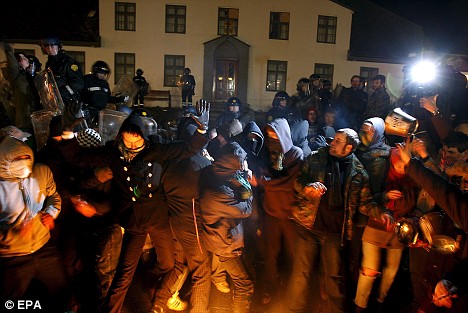
Icelandic government becomes first to be brought down by the credit crunch


By Graham Smith
Last updated at 3:10 PM on 23rd January 2009

Quit: Iceland's Prime Minister Geir Haarde called a general election for May. He also revealed he has cancer and will not be standing for re-election
The government of Iceland today became the first to be effectively brought down by the credit crunch.

After several nights of rioting over the financial crisis, Prime Minister Geir Haarde, surrendered to increasing pressure and called a general election for May.

A poll would not normally be held until 2011.

Haarde also revealed that he had been diagnosed with a malignant tumour of the oesophagus and would not seek re-election.

'I have decided not to seek re-election as leader of the Independence Party at its upcoming national congress,' he told a news conference.

The global financial crisis hit Iceland, which has a population 320,000, in October, triggering a collapse in its currency and financial system under the weight of billions of dollars of foreign debts incurred by its banks

The economy is set to shrink 10 percent this year and unemployment is surging.

Critics wanted Haarde, the central bank governor and other senior officials to resign.
Some senior figures in his party have also said they favour an early election, but Haarde had up to now vowed to defy plunging popularity and stay on.

Protests had been held weekly since the crisis broke last year, but since Tuesday have been held every night.

On Thursday, police used teargas on demonstrators for the first time since protests against the North Atlantic island's entry into the NATO alliance in 1949.

Special forces had to rescue Haarde from his car after he was surrounded by an furious mob hurling eggs and cans outside the government offices, in Reykjavik.


Protesters clash with police in Reykjavik during a demonstration against the Icelandic government's handling of the country's financial crisis

Riot police huddle together as projectiles are thrown at the Parliament building behind them in downtown Reykjavik
The seething crowd spattered the building with paint and yoghurt, yelling and banging pans, hurling fireworks and flares at the windows and even lighting a fire in front of the main doors.

'There were a couple of hundred (protesters) when they had to use the gas,' police spokesman Gunnar Sigurdsson said. 'It went on for two hours or so. There were no arrests. Some injuries, but not serious.'

Latvia, Bulgaria and other European countries hit hard by the global economic meltdown have also seen unrest.


Protesters carry a placard of Iceland's Justice Minister Bjorn Bjarnason and a sign reading 'death power' during demonstrations

Monday, January 19, 2009

Zimbabwe Currency Facing Extinction

Despite government denials that economy has been “dollarised”, local currency virtually unacceptable as legal tender.

By Chipo Sithole in Harare (ZCR No. 174, 7-Jan-09)

Grocery purchases, public hospital bills, property sales, rent, legal fees, vegetables and even mobile phone recharge cards in Zimbabwe are now paid for in foreign currency as the worthless Zimbabwe dollar virtually ceases to be legal tender.

Once a regional economic model, Zimbabwe is in the throes of an economic crisis, with unemployment running at more than 80 per cent and many families unable to afford a square meal. Stratospheric inflation (officially estimated, in July, to have reached 231 million per cent) and an unstable exchange rate have caused the Zimbabwe dollar to lose both credibility and its value as a trading currency.

However, the government of long-time ruler President Robert Mugabe is too ashamed to admit that it has officially "dollarised" the economy, so the Zimbabwean dollar remains the de jure legal tender of the country, leading to a situation economists term "partial dollarisation".

Full or official dollarisation is the adoption by one country of another’s currency as legal tender. In the case of Zimbabwe, the US dollar and the South African rand are widely accepted. The adopted currencies have taken over all the functions of domestic currency.

In order to attract foreign currency into the official market, Zimbabwe’s central bank has, since September, licensed at least 1,000 shops to sell goods in foreign currency. The authorities have also recently licensed mobile phone service providers to accept foreign exchange for airtime and other services, and permits public hospitals to receive payment in other currencies.

Other shops and service providers have followed suit, despite warnings that those who flout the country’s foreign exchange regulations will be prosecuted.

Political analysts and economists say the main reason for the government’s failure to admit to dollarisation or partial dollarisation is that the situation is difficult to reconcile with Mugabe’s oft-repeated declaration of his country’s "sovereignty" and frequent “anti-imperialist” outbursts.

"Such a declaration [of dollarisation] would be an embarrassment to a government which professes hatred of the US government," Lance Mambondiani, an investment analyst, said.

"At a symbolic level, one of the most important national symbols is money, which serves to enhance a unique sense of national identity. The currency underscores the fact that everyone is part of the same social entity," he said. "These effects are lost when money of a foreign state is adopted. Dollarisation is therefore a greater threat to national sovereignty than any perceived threat of recolonisation by the British."

There is another problem. Full dollarisation would require the approval of the US Federal Reserve, which is unlikely to be forthcoming, given the animosity between Washington and Harare.

Mugabe accuses the US government and former colonial power Britain of attempting to bring down his government through sanctions imposed in 2001 in response to political repression and electoral theft in Zimbabwe. In turn, Washington accuses Mugabe of having run down a once thriving economy through insane economic policies.

Diplomatic sources say America has asked the Mugabe regime to come clean on whether it has officially dollarised. Sizani Weza, a spokesperson at the US embassy in Harare, maintains, however, that, although he is “aware of public interest in US government approval or disapproval of the use of the US dollar in Zimbabwe” the US government has not “expressed an opinion” on the issue.

"As far as we know Zimbabwe has not officially dollarised. The US dollar circulates in Zimbabwe, as it does in many countries,” he said.

Weza said the US has simply expressed an interest in knowing whether dollarisation is now official policy so it can establish what short-term and long-term returns are due to it.

A senior government official said Zimbabwe had approached South African finance minister Trevor Manuel and South African Reserve Bank governor Tito Mboweni with a proposal that they rescue the Zimbabwean economy by extending the common monetary area of rand into Zimbabwe. It currently encompasses South Africa, Namibia, Lesotho and Swaziland.

Similar proposals have been made by Steve Hanke, Cato Institute Senior Fellow and Professor of Applied Economics at Johns Hopkins University, who advocates the creation of a currency board to end Zimbabwe's spiralling inflation, and by Tomaz Salamao, executive secretary of the Southern African Development Community, SADC.

Tomaz has reportedly suggested that Zimbabwe's depleted foreign reserves be topped up with the South African currency and that Zimbabwe be allowed to join the rand monetary area.

The Zimbabwe government, invoking its sovereignty mantra, initially rejected the suggestion, but IWPR has learnt that it has backed down under the pressure of the imploding economy and proposes issuing Zimbabwean dollars that are fully backed by and convertible into rands at a fixed rate.

Under this plan, the currency board will initially be capitalised by South Africa and the rand will be allowed to circulate legally in Zimbabwe.

"The rand would effectively prop up the Zimbabwe dollar," which has become almost worthless, said a government official.

The ultimate aim would be to stabilise the exchange rate of the Zimbabwe dollar and curb hyperinflation, enabling the country to buy foreign exchange and continue to import essential goods.

According to diplomatic sources, the price of South Africa's help will be Mugabe's commitment to a genuine power-sharing arrangement with the opposition in terms of the agreement signed on September 15, 2008, and to far-reaching political and economic reforms.

The power-sharing deal, which, it was hoped, would halt Zimbabwe’s plunge to destruction, has stalled over the allocation of key cabinet ministries.

Chipo Sithole is the pseudonym of an IWPR journalist in Zimbabwe.

Sunday, January 18, 2009

Dollar’s days as dominant currency numbered

Written by John Kemp

The shift in the status of the dollar is probably already under way as faith in the once-invincible greenback and US financial system declines.
January 19, 2009: For the world monetary system, the financial crisis which erupted in the summer of 2007 is a cataclysmic shift that will prove every bit as significant as the outbreak of the First World War (which heralded the sterling’s demise as a reserve currency) and the suspension of gold convertibility in 1971 (which marked the end of bullion’s monetary role).

The crisis marks the passing of an era in which the US dollar has been the world’s undisputed reserve currency for making international payments and storing wealth.

The dollar is not about to lose its reserve status completely. But it is set to become less “special”. In future, it will increasingly have to share its reserve status with the euro, the yen and perhaps the currencies of the other advanced economies. In time, it may even have to share its status with China’s yuan.

In fact, the whole concept of a single reserve currency (the dollar) and a principal reserve asset (US Treasury bonds) is set to undergo a profound shift. Policymakers, businesses and households will in future think about and hold a whole portfolio of competing reserve currencies and assets.

Multipolarity in the world of security and economic relations is set to be matched by a world with multiple reserve currencies. One positive consequence may be greater stability in a more diversified financial system, once the current crisis is passed.

But the price for the United States may be a loss of policy autonomy for Treasury and Federal Reserve officials used to being able to ignore the international dimension when deciding interest rates and budget deficits.

Leading economists agree that global imbalances lie at the root of the current crisis. But opinions are more sharply divided on their origins, which countries are to blame, and what should be done to resolve them.

The Fed’s critics argue that cheap money policies in the late 1990s and early 2000s are mainly responsible for fuelling a debt-driven consumer boom, and sucking in record volumes of imports, many from the newly industrializing economies of Asia.

Funding all this required issuing huge volumes of debt, much of it securitised against dubious mortgages and consumer debts, and sold to foreigners when domestic savings proved inadequate.

In contrast, Fed Chairman Ben Bernanke and some leading commentators blame China. In their view, China’s reliance on export-led growth, refusal to allow the yuan to appreciate, accumulation of foreign reserves, and recycling of surplus foreign exchange back into the market for US government bonds and mortgage-backed securities created a “global savings glut”.

This glut artificially reduced global interest rates and created the perverse incentives for an unsustainable build up of debt in the United States.

Differing interpretations about the origin of the imbalances lead to the two sides to proffer different solutions. Fed critics argue the solution lies in a long-term tightening of US credit conditions and higher domestic savings. Bernanke and his supporters argue the solution is for China to stimulate domestic demand, appreciate the yuan and reduce reserve accumulation.

In reality, it takes both a lender and a borrower to create a debt crisis; the solution to the crisis lies in balanced adjustments on both sides.

While it is tempting to blame China’s “mercantilist” trade policies for the crisis, China is only the latest in a long line of countries the United States has blamed for its own trade and financial problems (Germany and France in the 1960s, Japan in the 1970s and 1980s, the Asian Tigers in 1990s).

But it seems more likely there is something that makes the United States uniquely prone to excess domestic spending and running large trade deficits that in put pressure on the country’s external position.

Several Candidates
There are several candidates for the source of American exceptionalism. But perhaps the most obvious cause is the role of the dollar. The United States has run larger budget and current account deficits than most other countries simply because as the issuer of the principal reserve currency it can.

The positive side has been the ability to borrow more cheaply and in larger amounts than other countries. The dark side has been a steady accumulation of internal and more importantly external debt that is now a source of enormous financial instability.

This paradox linked to the provision of the world’s reserve currency was first noted by Yale economist Robert Triffin. In a famous warning to Congress in 1960, Triffin explained that as the marginal supplier of the world’s reserve currency the United States had no choice but to run persistent current account deficits. As the global economy expanded, demand for reserve assets increased.

These could only be supplied to foreigners by America running a current account deficit and issuing dollar-denominated obligations to fund it. If the United States stopped running balance of payments deficits and supplying reserves, the resulting shortage of liquidity would pull the global economy into a contractionary spiral.

Excess Liquidity
But Triffin warned that if the deficits continued, excess global liquidity risked fuelling inflation. Worse still the build up in dollar-denominated liabilities might cause foreigners to doubt whether the United States could maintain gold convertibility or might be forced to devalue.

Triffin was writing in a world of fixed exchange rates, but his work provides a useful way of thinking about the current crisis. In the 1950s, the fear was convertibility of greenbacks into gold.

Today, the fear is dollar devaluation, inflationary default on Treasury bonds, or capital losses on securitised products linked to widespread insolvencies.

Triffin’s work suggests that the Fed did have a choice in the late 1990s and early 2000s, albeit an unpalatable one. Officials could have refused to supply the incipient demand for liquidity.

Higher interest rates could have prevented the (worldwide) borrowing boom and widespread deterioration of financial standards seen in recent years. But they would also have meant lower growth in the United States and the rest of the world.

Instead, senior officials chose to accommodate overseas demand and reserve accumulation. Low interest rates and the resulting current account deficit provided record liquidity to the rest of the world but at the price of deteriorating credit standards and increasing fragility.

The United States is not the first country to discover the perils as well as the benefits of issuing the world’s main reserve currency. The United Kingdom experienced chronic instability during in the 1918-1939 period in part because the large outstanding “sterling balances” overseas threatened to overwhelm the country’s limited gold reserves and financial system if reserve holders tried to convert them into gold or other currencies.

Maintaining sterling’s convertibility into gold and the integrity of the sterling area required a recognition that attempted conversion would involve “mutually assured destruction” (the United Kingdom would be forced off gold and the Dominions would find the value of their sterling holdings cut). The United States and China are now locked in a similar embrace over China’s massive holdings of U.S. Treasury bonds.

But perhaps the clearest warning about the problems of being the dominant supplier of reserves to the rest of the world was issued by Henry Fowler, secretary of the U.S. Treasury in the mid-1960s: “Providing reserves and exchanges for the whole world is too much for one country and one currency to bear”.

Triffin’s own solution to the dilemma — the creation of new sources of liquidity based on issuing more IMF special drawing rights that would not be liability for any one country— is politically unrealistic.

But reducing reliance on the dollar and US Treasuries and supplementing them with other reserve assets is a necessary step to reduce system fragility. The shift is probably already under way as faith in the once-invincible dollar and US financial system declines.

Friday, January 16, 2009

Rescue of U.S. banks hints at nationalization

By Edmund L. Andrews
Friday, January 16, 2009
WASHINGTON: Last fall, as Federal Reserve and Treasury Department officials rode to the rescue of one financial institution after another, they took great pains to avoid doing anything that smacked of nationalizing banks.

They may no longer have that luxury. With two of the nation's largest banks buckling under yet another round of huge losses, the incoming administration of Barack Obama and the Federal Reserve are suddenly dealing with banks that are "too big to fail" and yet unable to function as the sinking economy erodes their capital.

Particularly in the case of Citigroup, the losses have become so large that they make it almost mathematically impossible for the government to inject enough capital without taking a majority stake or at least squeezing out existing shareholders.

And the new ground rules laid down by Obama's top economic advisers for the second half of the $700 billion bailout fund, as explained in a letter submitted to Congress on Thursday, call for the government to play an increasing role in the major activities of the banks, from the dividends they pay to shareholders to the amount they can pay executives.

"We are down a path that this country has not seen since Andrew Jackson shut down the Second National Bank of the United States," said Gerard Cassidy, a banking analyst at RBC Capital Markets. "We are going to go back to a time when the government controlled the banking system."

The approximately $138 billion aid package on Thursday for Bank of America — including injections of capital and absorbed losses — as well as a $300 billion package in November for Citigroup both represented displays of financial gymnastics aimed at providing capital without appearing to take commanding equity stakes.

Treasury and Fed officials accomplished that trick by structuring the deals like insurance programs for big bundles of the banks' most toxic assets.

Instead of investing tens of billions of taxpayer dollars in exchange for preferred shares in the banks, which has been the Treasury Department's approach so far with its capital infusions, the government essentially liberated the banks from some of their most threatening assets.

The trouble with the new approach, analysts say, is that it is likely to conceal the amount of risk that taxpayers are taking on. If the government-guaranteed securities turn out to be worthless, the cost of the insurance would be much higher than if the Treasury Department had simply bailed out the banks with cash in the first place.

Christopher Whalen, a managing partner at Institutional Risk Analytics, said the approach also covers up the underlying reality that the government is already essentially the majority shareholder in Citigroup.

"There's nobody else out there to invest in them," Whalen said. "We already own them."

Ben Bernanke, chairman of the Federal Reserve Board, outlined the elements of what could become the Obama administration's new approach to bank rescues in a speech on Monday.

Speaking to the London School of Economics, but addressing American audiences as much as European ones, Bernanke warned that the U.S. government had no choice but to put more money into banks and other financial institutions if it had any hope of reviving the paralyzed credit markets.

Known officially as the Troubled Asset Relief Program, or TARP, the rescue program has infuriated lawmakers in both parties, who complain that Treasury Secretary Henry Paulson Jr. has doled out money to banks without demanding accountability in return. Obama and his top economic advisers convinced enough lawmakers that shoring up the banks was essential to preventing a broader financial collapse, and offered written assurances that they would address the lawmakers' biggest complaints.

But Bernanke proposed an array of alternative approaches to dealing with the banks in the months ahead, and all of those options reflected a fundamental shift from the original assumptions of the Bush administration.

Paulson had insisted that the government would be investing only in healthy banks, some of which might take over sicker rivals. The Treasury would invest taxpayer dollars in exchange for preferred shares, which would pay a regular dividend and come with warrants that would allow the government to profit from increases in company stock prices.

By contrast, Bernanke proposed various ways to fence off the troubled assets, from nonperforming loans to mortgage-backed securities that investors had stopped buying at almost any price.

Bernanke's options included guarantees for bank assets, which was at the heart of the rescue packages for Bank of America and Citigroup. Citigroup received its rescue package in November, but it is expected to report additional losses on Friday that could top $10 billion.

In both of those deals, the U.S. government set up a complicated arrangement that would limit the banks' losses on hundreds of billions of dollars worth of their worst assets.

Citigroup's deal in November covered $300 billion in assets. Citigroup agreed to absorb the first $29 billion in losses. The Treasury agreed to take a second round of losses up to $5 billion, and the Federal Deposit Insurance Corporation agreed to take a third round of losses of up to $10 billion. The Federal Reserve then agreed to lend Citigroup money at low interest rates for the value of the remaining assets.

As a second option, Bernanke and other Fed officials have proposed putting a bank's impaired assets into a separate new "bad bank." The effect would be much the same as providing a federal guarantee: the bank would be able to free itself from the need to set aside reserves for extra losses.

Both the idea of a government "wrap" and a government-backed "bad bank" have the virtue of protecting the bank's common stockholders from being wiped out by the government.

By contrast, the Bush administration's original approach to recapitalizing banks — injecting capital in exchange for preferred shares with warrants to convert to common stock — had the effect of squeezing out the common shares. That was because any losses would have to first wipe out common stockholders before the bank could stop paying dividends on preferred shares.

"One of the problems with TARP has been a result of the government not wanting to own the banks," said Fred Cannon, chief equity strategist at Keefe, Bruyette & Woods. "If you get losses, there is less common stock. What we are hopefully moving toward, to the extent that the government guarantees some of the assets, is a structure that protects common shareholders and allows the company to go out and raise common shares through the market."

But a growing number of analysts warned that the approach may be too clever, because it gives policy makers too many ways to conceal true problems at banks and true risks to taxpayers.

"What we have is a weird, shadow nationalization," said Karen Shaw Petrou, managing partner at Federal Financial Analytics, a consulting firm in Washington. "The government does not want to and should not want to own banks. But if they get forced into that situation, they should resolve that situation. Here, what you have is a huge diversified financial services industry with recognized losses and looming losses in every aspect of its operations. There's nothing straightforward about it."

Friday, December 26, 2008

The Federal Reserve Abolition Act

Stephen Lendman
Global Research
December 25, 2008

On June 15, 2007, Ron Paul introduced HR 2755: Federal Reserve Abolition Act. There were no co-sponsors, no further action was taken, and the legislation was referred to the House Committee on Financial Services and effectively pigeonholed and ignored.

Creating the Federal Reserve System to let bankers and not the government control the price and amount of fiat money debased the currency and is the root cause of today’s financial problems.
It’s a bold and needed measure to “abolish the Board of Governors of the Federal Reserve System and the Federal reserve banks, to repeal the Federal Reserve Act, and for other purposes.”

The bill provides for management of employees, assets and liabilities of the Board during a dissolution period, and more as follows:

– it designates the Director of the Office of Management and Budget to liquidate Fed assets in an orderly and expeditious manner;

– transfer them to the General Fund of the Treasury after satisfying all claims against the Board and any Federal reserve bank;

– assume all outstanding Board and member bank liabilities and transfer them to the Secretary of the Treasury; and

– after an 18-month period, submit a report to Congress “containing a detailed description of the actions taken to implement this Act and any actions or issues relating to such implementation that remain uncompleted or unresolved as of the date of the report.”

On November 22, “End the Fed” protests were held in 39 or more cities nationwide (including New York, Chicago, Los Angeles and Washington, DC), but you’d hardly know it for lack of coverage. Attendee demands were simple and emphatic:

– end a private banking cartel’s illegal monopoly control over the nation’s money supply and price;

– return that power to the US Treasury as the Constitution mandates;

– end a fiat currency system backed by the waning full faith and credit of the government; and

– return the country to a sound, hard currency monetary system.

“End the Fed! Sound Money for America!” is their slogan, and writer and US policy critic Webster Tarpley puts it well:

“….the privately owned central bank….has been looting and wrecking the US economy for almost a hundred years. We must end a system where unelected, unaccountable cliques of bankers and financiers loyal to names like Morgan, Rockefeller, and Mellon set interest rates and money supply behind closed doors, leading to de-industrialization, mass impoverishment, and a world economic and financial depression of incalculable severity.”

In theory, the Fed was established to stabilize the economy, smooth out the business cycle, manage a healthy, sustainable growth rate, and maintain stable prices. In fact, it failed dismally. It contributed to 19 US recessions (including the Great Depression) and significantly to the following equity market declines that accompanied them as measured by the Dow or S & P 500 average - the S &P’s inception was 1923; it became the S & P 500 in 1957:

– 40.1% (Dow) from 1916 - 1917;

– 46.6% (Dow) from 1919 - 1921;

– the 1929 (Dow) crash in two stages - 47.9% in 1929 followed by a strong, temporary rebound; then - 86%; an 89% peak to trough total from October 1929 to July 1932;

– 49.1% (Dow) from 1937 - 1938;

– 40.4% (Dow) from 1939 - 1942;

– 25.3% (S & P) from 1946 - 1947;

– 19.8% (S & P) in 1957;

– 26.8% (S & P) from 1961 - 1962;

– 19.3% (S & P) in 1966;

– 32.7% (S & P) from 1968 - 1970;

– 45.1% (S & P) from 1973 - 1974;

– 20.2% (S & P) from 1980 - 1982;

– 32.9% (S & P) in 1987;

– 19.2% (S & P) in 1990;

– 18.8% (S & P) in 1998;

– 49.1% (S & P) from 2000 - 2002; and

– about 50% (S & P) and counting (excluding a bear market rebound) from October 2007.

The Fed is also directly responsible for monetary inflation and the decline in the US standard of living since its year end 1913 inception and especially since the 1970s. From the late 18th century to 1913, virtually no inflation existed under the gold standard except during times of war. Using government data, it now takes over $2000 to equal $100 of pre-Fed purchasing power. In other words, a 1913 dollar is worth about a nickel today.

At that time, a dollar was defined as 1/20 of an ounce of gold or about an ounce of silver. The Fed then changed the standard away from precious metals to the full faith and credit of the government. Ever since (except for periods such as the 1930s) inflation eroded the currency’s value and (more than ever) continues to do it today.

It’s why one analyst calls the dollar “nothing more than a popular symbol for the tangible substances it once represented - gold and silver.” Its true value represents the world’s waning confidence in America’s ability to honor its debt obligations, and with good reason.

Under the Federal Reserve System (besides inflation), we’ve had rising consumer debt; record budget and trade deficits; a soaring national debt; a high level of personal and business bankruptcies; today, millions of home foreclosures; high unemployment; the loss of the nation’s manufacturing base; growing millions in poverty; an unprecedented wealth gap between the rich and all others; and a hugely unstable economy now lurching into crisis mode.

In a November 24 Wall Street Journal op-ed, Hong Kong-based author and equity strategist Christopher Wood believes “The Fed Is Out of Ammunition.” With trillions in personal wealth erased, “there is little doubt that we are witnessing a classic debt-deflation bust at work, characterized by falling prices, frozen credit markets and plummeting asset values.”

He notes how “over-investment and over-speculation” on borrowed money got us here. Today, the Fed can control the supply of money but not its velocity or the rate it turns over. The current collapse set it in reverse with no signs of an impending turnaround.

Wood believes monetary and fiscal measures won’t work. There are no easy solutions - “not as long as politicians and central bankers (won’t) let financial institutions fail,” and let market forces wash out excesses over time.

The Fed and Treasury will spend trillions of dollars to correct things, “but will merely compound (the problem) by adding debt to debt.” The current crisis will end up “discrediting mechanical monetarism - and with it the fiat paper-money system….The catalyst will be foreign creditors fleeing the dollar for gold. That will in turn lead to global recognition of the need for a vastly more disciplined global financial system” with gold very likely playing a part.

Absent a hard money currency has led to the kind of monetary madness that Nouriel Roubini calls “crazy” policy actions - an explosion of quantitative easing in the trillions with no end of it in sight.

Roubini: “The Fed Funds rate has been abandoned…as we are already effectively at (zero interest rates) that signal a liquidity trap….Even (a sharp) fall in mortgage rates….will be of small comfort to debt burdened households as only those (that) qualify for refinancing will be able to” net out a “modest” monthly mortgage saving of about $150.

The Fed’s “desperate policy actions….will eventually lead to much higher real interest rates on the public debt and weaken the US dollar (the result of a) tsunami of implicit and explicit public liabilities and monetary debt.” It will get foreign investors to “ponder the long-term sustainability of the US domestic and external liabilities,” and why not. They keep growing exponentially, and with nothing restraining a runaway Fed, dollar debasing may continue to the point where no one will want to hold them. It’s gotten some analysts to recommend moving a portion of savings out of them into gold - the ultimate safe haven in times of crisis.

Abolish the Fed and Return the Nation’s Money Creation Power to Congress Where It Belongs

Ron Paul has been in the vanguard of the Abolish the Fed movement, and on September 10, 2002 on the House floor said:

“Since the creation of the Federal Reserve, middle and working-class Americans have been victimized by a boom-and-bust monetary policy. In addition, most Americans have suffered a steadily eroding purchasing power because of the Federal Reserve’s inflationary policies. This represents a real, if hidden, tax imposed on the American people….”

“It is time for the Congress to put the interests of the American people ahead of the special interests. Abolishing the Federal Reserve will allow Congress to reassert its constitutional authority over monetary policy.”

“Abolishing the Federal Reserve and returning to a constitutional system (as mandated) will enable America to return to the type of monetary system envisioned by our nation’s founders: one where the value of money is consistent because it is tied to a commodity such as gold….I urge my colleagues (to co-sponsor) my legislation to abolish the Federal Reserve.”

Paul introduced his legislation in the 106th, 107th, 108th, and 110th Congresses. Each time, it died in committee. On November 22, he attended the End the Fed rally in Houston and addressed the crowd.

He called the current economic crisis as bad or worse than in the 1930s and said: “we know who caused it. It was the Federal Reserve that gave us all this trouble.” He explained that we had a “free ride for decades because we’ve had a system that was devised where the dollar could act as if it were gold.”

Not after August 1971 when Nixon closed the gold window, ended the 1944 Bretton Woods Agreement, and no longer let dollars be backed by gold or converted into it in international markets. A “new economic system” was created. It let us “spend beyond our means, live beyond our means, print money beyond our means,” and it caused our current dilemma.

We created “an appearance of great wealth. But it was doomed to fail,” and it became apparent in the past year: “the failure of the dollar reserve standard that was set up in August of 1971. It has ended. The only question” is what will replace it?

There’s all kinds of talk, including setting up a new international fiat currency “with the loss of US sovereignty in total. We have to stop this move towards one world government and a one world currency.” Otherwise our freedom and Constitution will be lost. When it was written, it contained prohibitions.

A d v e r t i s e m e n t
Article I, Section 8 gives Congress alone the right to coin (create) money and regulate the value thereof. The founders also wanted gold and silver to be legal tender, not fiat money, nor should there be a central bank. In 1935, the Supreme Court ruled that Congress cannot constitutionally delegate this power to another body. By creating the Federal Reserve System in 1913, Congress violated the Constitution it was sworn to uphold and defrauded the American public. Today’s crisis is the fruit of its action, but watch out.

“The writing is on the wall, and the end of this system” approaches. “They cannot patch it up, they can’t up it back together again. They know it and we know it. The only argument is what is it going to be replaced with?”

For now, “Central banks in the West especially have been dumping gold to artificially lower (its price) to pretend the dollar is of great value. They’re still doing it, but they’re running out of time (and) out of gold.” It’s shifting to stronger economic powers, ones who’ve been saving money, loaning it back to us, “and are ready to buy up America if we continue to do this. So it is a contest (between fiat) money and hard money, and that is such an important issue.” It reflects what Daniel Webster once said:

“There can be no legal tender in this country….but gold and silver. This is a constitutional principle….of the very highest importance.” Gold, however, wasn’t the original monetary system standard. Silver was, the silver dollar, and only a constitutional amendment can change it.

Paper currency as well, whether backed by gold or not, wasn’t the hard money authorized by the Constitution. Honest money is honest weights and measures of silver and gold. Federal Reserve Notes are paper fiat debt obligations. Fiat currency of any kind is a mechanism of wealth transference from the public to a privileged elite - through inflation and loss of purchasing power. It creates debt for the many and wealth for the few, especially when a private banking cartel controls it.

Our existing monetary system combines money, credit and debt into a dishonest system of empty promises in exchange for future ones. There is no eventual payment, only unfulfillable assurances to new generations that will be forced to pay for the debt now accumulated. It’s a moneychangers dream - ever-expanding debt and a continuing interest rate stream, masquerading as wealth creation for the people. It’s in fact a system of bondage and indebtedness benefitting the few at the expense of the many, a modern-day feudalism. It’s how an elite 1% got to own 70% of the nation’s wealth.

In the 1920s, Josiah Stamp, Bank of England president said:

“Banking was conceived in iniquity and was born in sin. Bankers own the earth. Take it away from them, but leave them the power to create deposits, and with a flick of the pen (today a computer keyboard) they will create enough deposits to buy it back again. However, take it away from them, and all the great fortunes like mine will disappear, and they ought to disappear, for this would be a happier and better world to live in. But if you wish to remain the slaves of Bankers and pay the cost of your own slavery, let them continue to create deposits.”

Creating the Federal Reserve System to let bankers and not the government control the price and amount of fiat money debased the currency and is the root cause of today’s financial problems. A return to honest gold and silver weights and measures is needed. The Constitution states that nothing but these metals are money and that paper bills of credit (like Federal Reserve notes) aren’t allowed. Even ones backed by gold as the Constitution doesn’t grant Congress the power to be bankers. It may only coin (create) and borrow money, not loan it out or give it away - and certainly not to bankers at the expense of the public interest.

Further, the Constitution contains no provision allowing Congress to enact legal tender laws. Article I, Section 10 forbids the individual states from making “anything but gold and silver coin a legal tender in payment of debts.” However, US Code, 31 USC 5103, establishes US coins and currency, including Federal Reserve notes, as legal tender and has been used to debase the currency ever since - the way Gresham’s Law works: bad (or debased) money drives out good (the kind with little difference between its nominal and commodity values).

For example, until 1964, US coins (except pennies and nickels) contained 90% silver. Starting in 1965, dimes and quarters were converted to their current nickel - copper composition. Half-dollars (now produced in limited quantities) had 90% silver. It then dropped to 40% in 1965 and by 1971 all US coins (except pennies and commemorative mintings) contained nickel and copper and no silver - a good example of debasing. As for paper currency, it’s just paper.

Under a private banking cartel’s control, it’s been misused, stolen, and corrupted the way New York Times columnist Floyd Norris suggests in his November 24 article headlined: “Another Crisis, Another Guarantee.” First the banks, then the auto companies, and who knows who’s next in line for theirs. “As the nation’s obligations rise into the trillions, at some point investors (and the public) may begin to question whether a government running huge deficits can also credibly promise that the dollar will not lose its value.” How can there be any faith and credit left when it’s vanishing and the Fed and Treasury operate like giant hedge funds.

It got UK-based Eclectica Asset Management chief investment officer, Hugh Hendry, concerned enough to say: “All (US) financials will be owned by the government in a year. I bet you. It’s not good,” but it’s coming. US taxpayers will be “paying for this for a long time,” and it’s deeply concerning considering the amount of money creation - with no end in sight as problems keep mounting and limitless amounts keep being thrown at them.

On November 25 the Financial Times associate editor, Wolfgang Munchau, also worries about the Fed’s “weapon of mass desperation” (so-called quantitative easing); focusing only on deflation and risking a currency crisis. He calls it a flawed, dangerous and shocking oversight - the possibility of “a mass flight out of dollar assets (at some point) and a large rise in US market interest rates, followed by a huge recession.”

A Bloomberg.com November 24 headline highlights the problem: “US Pledges Top $7.7 trillion to Ease Frozen Credit,” and it might as well have said there’s plenty more where that came from if needed. With another $800 committed to two new loan programs the total reached $8.5 trillion, according to Bloomberg or nearly 60% of US 2007 GDP of $14 trillion, and the numbers keep rising exponentially because the problems continue to mount.

Bloomberg puts it in perspective saying “the (current) commitment dwarfs (TARP and puts) Federal Reserve lending last week (at) 1900 times the weekly average for the three years before the crisis,” and with the added $800 billion it’s about 2100 times pre-crisis levels.

In addition, the Fed refuses to identify recipients of about $2 trillion of emergency handouts or what troubled assets (if any) it’s accepting as collateral. Call it lending or spending. They’re public tax dollars being spread around like confetti and debasing it all as a result.

The Free Lakota Bank

On November 21, this writer discussed how Lakotahs are treated in an article titled “Fate of Lakotahs Highlights America’s Failed Native American Policies.” On November 24, the following press release and follow-up information announced:

“People of Lakota Launch Private Bank for Only Silver and Gold Currencies.” All deposits are “liquid, meaning they can be withdrawn at any time in minted rounds. Some may confuse our economic system with isolationism….which it is not. Since we currently produce much more than we consume, we have the right to decide what medium of exchange to accept for our effort. And so we accept only value for value. Across our great land, over thousands of tribes and merchants participate in our system of trade. We invite others to trade with us and bring value back into our transactions.”

This is the world’s first non-reserve, non-fractional bank that accepts only silver and gold currencies for deposit. The Lakotas “invite people of any creed, faith or heritage to unite in an effort to reclaim control of wealth. It is our hope that other tribal nations and American citizens recognize the importance of silver and gold as currency and decide to mirror our system of honest trade.”

The bank states that it issues, circulates and accepts for deposit “only AOCS - Approved silver and gold currencies.” It calls paper not real money but “merely a promise to pay - a mortgage on wealth that does not exist, backed by a gun aimed at those who are expected to produce it. Since we deal only in real money, we do not participate in any central bank looting schemes.” When corruption is rewarded and “honesty becom(es) self-sacrifice….you may know that your society is doomed.” Even as victims of adversity, Lakotas are working to prevent it.

End the Fed

Privatized money control is the single greatest threat to democratic freedom. As former lawyer, economist, academic, and Canadian prime minister (from 1935 - 1948) William Lyon Mackenzie King once said:

“Until the control of the issue of currency and credit is restored to government and recognized as its most conspicuous and sacred responsibility, all talk of sovereignty of Parliament and of democracy is idle and futile….Once a nation parts with control of its credit, it matters not who makes (its) laws….Usury once in control will wreck any nation,” and indeed it has, far more now than ever.

It worried Thomas Jefferson enough to call banking institutions “more dangerous to our liberties than standing armies” at a much simpler time in our history. The right to create and control money belongs to the people through their elected representatives. For the past 95 years, powerful bankers accountable to no one have had it. They effectively run the country (and own it), and unless We the People change things, we’ll continue to be victimized by economic tyranny and the eventual political kind that’s coming.